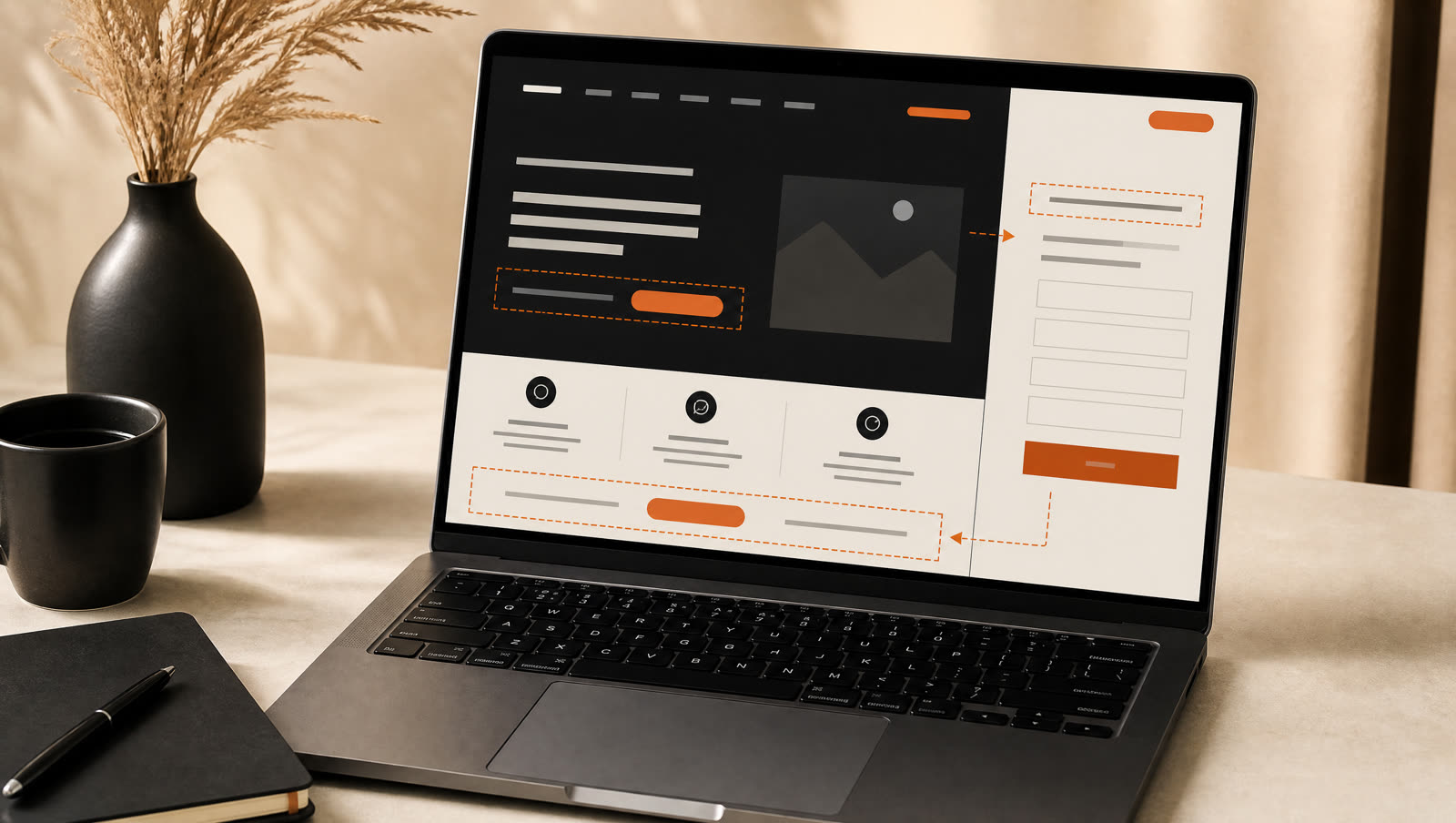
If your website is not getting enquiries, do not start by buying more traffic. Start by checking whether the page makes the next step obvious. Most weak small-business sites fail in the same places: unclear offer, poor mobile layout, hidden contact options, slow loading, weak trust, thin SEO, and no reason for the visitor to act now.
1. The homepage does not say what you do
This is the most common problem.
The hero section looks tidy. The typography is decent. The logo is polished enough. But a stranger still cannot tell what the business does in five seconds.
That is fatal.
A customer does not arrive on your website hoping to admire a layout. They arrive with a problem. Leak. Booking. Menu. Price. Availability. Treatment. Quote. They need to know whether you solve that problem.
Your first screen should answer:
- What do you do?
- Who is it for?
- Where do you work?
- What should I do next?
If it does not, the site is making visitors work too hard.
2. The page attracts the wrong intent
Not every visitor is equal.
Someone searching "how to fix a leaking tap" wants advice. Someone searching "emergency plumber near me" wants a phone number. If both land on the same vague service page, neither gets a clean answer.
That is why industry pages and service pages matter. A plumber website should treat emergency searches differently from planned bathroom work. A restaurant website should separate bookings, menus, opening hours, and private dining. The page has to match the search.
More traffic from the wrong query will not help. Better intent match will.
3. The contact option is hidden
Open the site on your phone.
Can you call, book, or enquire without hunting?
If the phone number is in the footer, the form is buried three clicks deep, or the button says something vague like "Learn more", the site is leaking enquiries.
For local service businesses, the contact option should be visible in the first screen. For trades, a tap-to-call button matters. For restaurants and cafés, the booking or menu link matters. For consultants, the enquiry form needs to be obvious and short.
4. The form is too long
Most small-business contact forms ask too much.
Name, email or phone, and a short message is enough for a first enquiry. You can ask the rest later.
Long forms feel like admin. Admin kills momentum.
Test the form from your phone. If it feels annoying to you, it feels worse to a customer who does not know you yet.
5. The site is slow on mobile
Speed is not just a technical score. It is a patience test.
Common causes:
- Images uploaded straight from a phone.
- Heavy themes.
- Too many plugins.
- Auto-playing video.
- Cookie banners that block the page.
- Fonts loaded badly.
If your site takes several seconds to show the main content, some visitors leave before they even read the offer. For local businesses, that is often the difference between your site and the next Google result.
6. There is not enough trust
Trust does not have to mean testimonials. Use what is honest and available.
For a small business, trust can be:
- Real photos.
- Clear pricing or starting prices.
- A named person.
- A visible location or service area.
- Accreditations.
- Opening hours.
- A clear process.
- A Google Business Profile link.
- Examples of what the customer gets.
The key is specificity. "High-quality service" says almost nothing. "Starter websites from £250, delivered in 10 business days" says something concrete.
7. The page is too thin for Google
Some pages are too thin to rank and too thin to convert.
The usual version is a service page with one paragraph, a stock image, and a contact button. Google cannot tell much from it. Customers cannot either.
A stronger service page should explain:
- Who the service is for.
- What is included.
- What it costs or starts from.
- What happens next.
- Common questions.
- Related services or locations.
That does not mean writing for the sake of length. It means giving enough useful detail for a customer to make a decision.
If the problem is local visibility, the next useful read is local SEO for a small business website. It covers the basics behind service pages, city pages, Google Business Profile, and internal links.
8. The site gives no reason to act now
You do not need fake urgency.
You do need a clear next step.
Good next steps:
- "Send the current site for a free check."
- "Ask for a fixed quote."
- "Call now for emergency work."
- "Book a table."
- "Send three photos of the job."
Weak next steps:
- "Learn more."
- "Submit."
- "Get in touch" hidden at the bottom.
If the visitor has decided they might need you, do not make the next action vague.
9. You do not know what is happening
If there is no analytics, no Search Console, and no form tracking, you are guessing.
You should know:
- Which pages people visit.
- Which pages bring search impressions.
- Which forms get submitted.
- Which buttons get clicked.
- Which queries bring traffic.
You do not need enterprise reporting. You need enough visibility to tell whether the site has a traffic problem, a conversion problem, or both.
Quick diagnosis table
| Symptom | Likely issue | First fix |
|---|---|---|
| People visit but do not enquire | Weak offer or contact path | Rewrite the first screen and test the form |
| No search traffic | SEO foundation is thin | Check titles, sitemap, indexing, and page depth |
| Mobile bounce feels high | Mobile layout or speed | Test on phone and compress images |
| Lots of calls from wrong customers | Message is too broad | Clarify service, location, and price |
| Good reviews but few leads | Reviews are not connected to the site | Link Google profile and add proof near CTA |
What I would check first
If you sent me your current site, I would check the first screen, mobile layout, contact path, metadata, speed, trust signals, and whether the page matches the search intent.
That is exactly what the free website check is for.
If the site only needs a fix, I will say that. If the structure is too weak, I will tell you what a rebuild would involve. If the whole site feels dated, read the old website redesign guide before you spend money. A focused Starter site is £250 and delivered in 10 business days. If your hard budget is below £500, read the website design under £500 guide before you choose.
FAQ
Why is my website not getting enquiries?
Usually because the offer is unclear, the contact path is weak, the site is slow on mobile, the page targets the wrong search intent, or there is not enough trust on the page.
Do I need more traffic or a better website?
Check the website first. If visitors already land on the site but do not call, book, or submit the form, more traffic will usually waste more money.
How do I know if my contact form is costing me leads?
Submit it yourself from a phone. Check whether it is easy to find, whether it works, whether the email arrives, and whether the thank-you message tells the visitor what happens next.
Can SEO fix a website that does not convert?
Not by itself. SEO can bring more visitors, but the page still has to explain the offer, build trust, and make the next step obvious.
Should I rebuild my site if it is not getting enquiries?
Sometimes. If the message, structure, mobile layout, speed, and ownership are all weak, rebuilding is usually cleaner than patching. If one or two things are broken, fixing those may be enough.