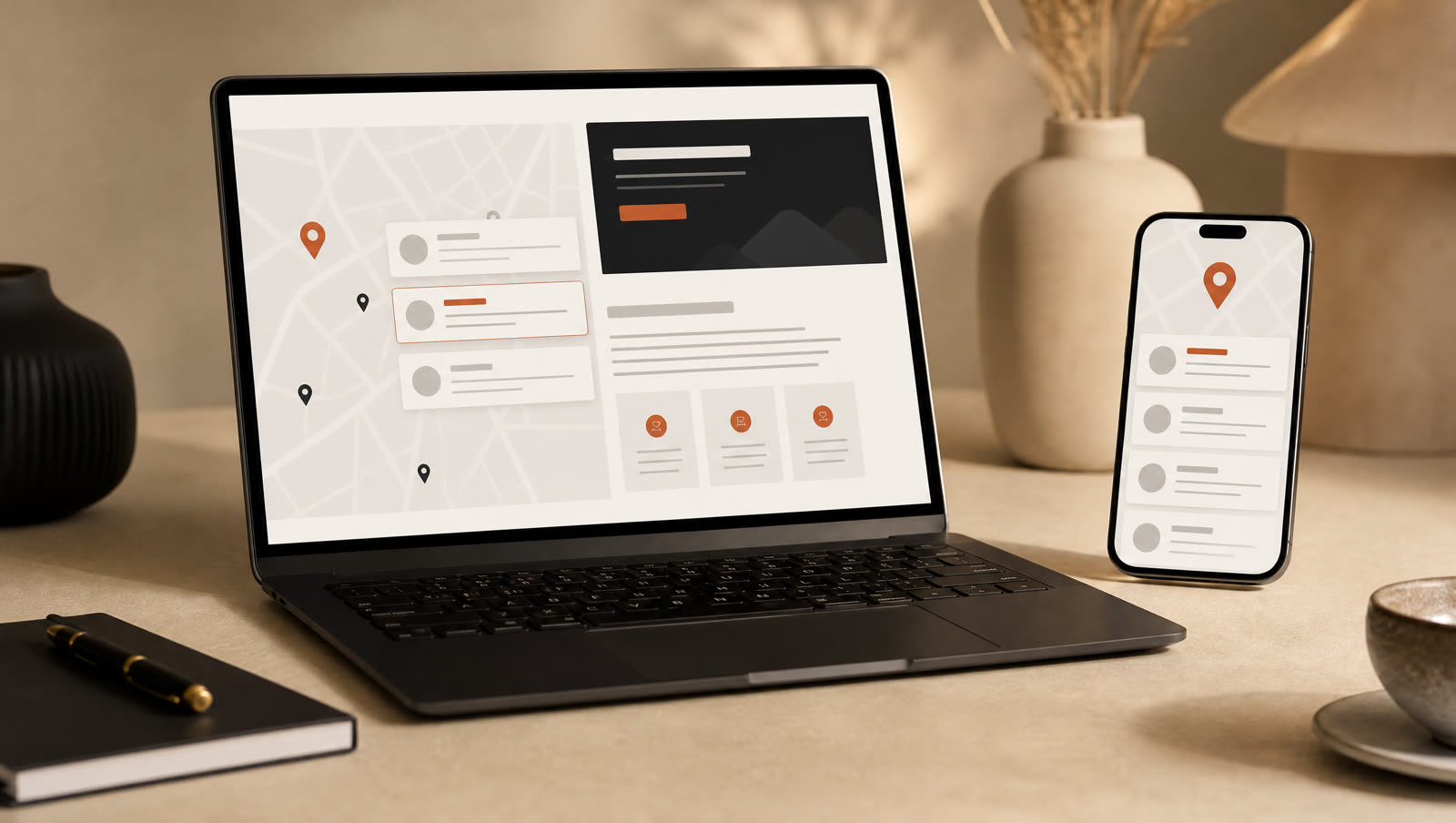
Local SEO for a small business website is not one trick. It is a set of basics done properly: clear service pages, real location language, a connected Google Business Profile, consistent contact details, fast mobile pages, useful titles, schema, reviews, internal links, and content that matches how customers actually search.
1. Service pages that match real searches
The strongest local SEO page usually combines a service and a place.
Examples:
- Emergency plumber in Manchester.
- Cafe in Brighton.
- Accountant in Leeds.
- Web designer in London.
- Wedding photographer in Bristol.
A general homepage can rank for the business name. It usually cannot carry every local service search by itself.
That is why service pages matter. Each page should answer one search intent properly: what the service is, who it is for, where it is available, what the next step is, and why the business is credible.
2. Location language that sounds real
Local SEO does not mean repeating the city name twenty times.
A useful local page mentions the city, but it also mentions real neighbourhoods, nearby areas, postcodes, customer patterns, and local context where it matters.
For example, a London web design page should not sound the same as a Manchester web design page. The customer base, competition, and local search patterns are different.
The same applies to trades, hospitality, clinics, and professional services. A page that feels written for a place is more useful than a page that only swaps the city name.
3. Google Business Profile connected to the site
Your Google Business Profile and website should point at each other.
Check:
- The website URL is correct on the profile.
- The business name matches.
- Phone number matches.
- Opening hours match.
- Address or service area matches.
- Service categories are sensible.
- Photos are current.
If the profile says one thing and the site says another, trust drops. Google has to reconcile the mismatch. Customers notice it too.
4. Name, address, and phone consistency
This is usually called NAP consistency.
For a small business, it means your business name, address, phone number, opening hours, and service area should be the same across:
- Website.
- Google Business Profile.
- Facebook.
- Instagram.
- Local directories.
- Trade directories.
- Review profiles.
You do not need hundreds of directory listings. You do need the important ones to agree.
5. Page titles that say the thing plainly
Page titles still matter.
A weak title:
Home | Smith & Co
A better title:
Accountant in Leeds for Small Businesses | Smith & Co
For CraftedPages, this is why the city pages use patterns like web designer in Birmingham, web designer in Bristol, and web designer in Cardiff. The page title has to tell search engines and customers what the page is about.
6. A mobile site that loads quickly
Local searches happen on phones.
If your site is slow or awkward on mobile, the customer does not wait politely. They go back to Google and tap the next result.
Check:
- Images are compressed.
- Buttons are easy to tap.
- Phone numbers use
tel:links. - Menus open cleanly.
- Forms work on mobile.
- The first useful content appears quickly.
This is not only a technical issue. It is a conversion issue.
7. Schema that describes the business
Schema is structured data that helps search engines understand the page.
For local SEO, useful schema can include:
LocalBusinessProfessionalServiceServiceFAQPageBreadcrumbListArticle
Schema will not rescue a weak page. It does help a clear page become easier for search engines and answer engines to read.
8. Reviews connected to the right pages
Reviews usually live on Google, but the website should make them easy to find.
That might mean:
- Linking to the Google Business Profile.
- Showing a few honest review snippets where allowed.
- Linking to official registers or directories.
- Showing real photos and work examples.
Do not invent proof. Use what the business actually has.
For CraftedPages, I do not claim public testimonials because the fact file does not support that yet. That constraint is useful. It keeps the page honest.
9. Internal links between related pages
Internal links help customers and crawlers understand the site.
A city page should link to relevant industries. An industry page should link to relevant cities. A blog post about weak enquiries should link to a free website check or the right service page.
This is why a plumber website page and a web designer London page should not sit isolated from the rest of the site. They belong in a cluster.
10. Content that answers real local questions
Good local SEO content answers the questions customers ask before enquiring.
Examples:
- Do you cover my area?
- How much does it start from?
- How fast can you do it?
- Do you handle this exact service?
- What should I send before you quote?
- Can I call, book, or submit a form?
If the page answers those clearly, it has a much better chance than a page filled with general marketing copy.
What I would check first
If your site is not showing up locally, start with:
- Google Business Profile URL.
- Homepage title.
- Service page titles.
- Mobile speed.
- Contact details.
- Sitemap and indexing.
- City or service-area page quality.
- Internal links.
If you want a quick first read, send the site through the free website check. If you need a fresh local SEO foundation, my fixed-price website plans start at £250.
FAQ
What is local SEO for a small business website?
Local SEO is the work that helps a business show up for service-plus-place searches, such as plumber in Leeds, cafe in Bristol, or web designer in London.
Do I need a separate page for every city?
Only if the page has real value. A useful city page explains how you serve that place. A thin page that swaps one city name for another is not worth publishing.
Does Google Business Profile replace a website?
No. The profile helps you appear in local results, but the website gives Google and customers deeper information about services, prices, areas, and trust.
How long does local SEO take?
Indexing can happen within days or weeks, but ranking depends on competition, reviews, content quality, location, links, and time.
Can a new small business rank locally?
Yes, especially for specific long-tail searches. Broad city terms are harder. Specific service, location, and neighbourhood searches are usually the better first target.