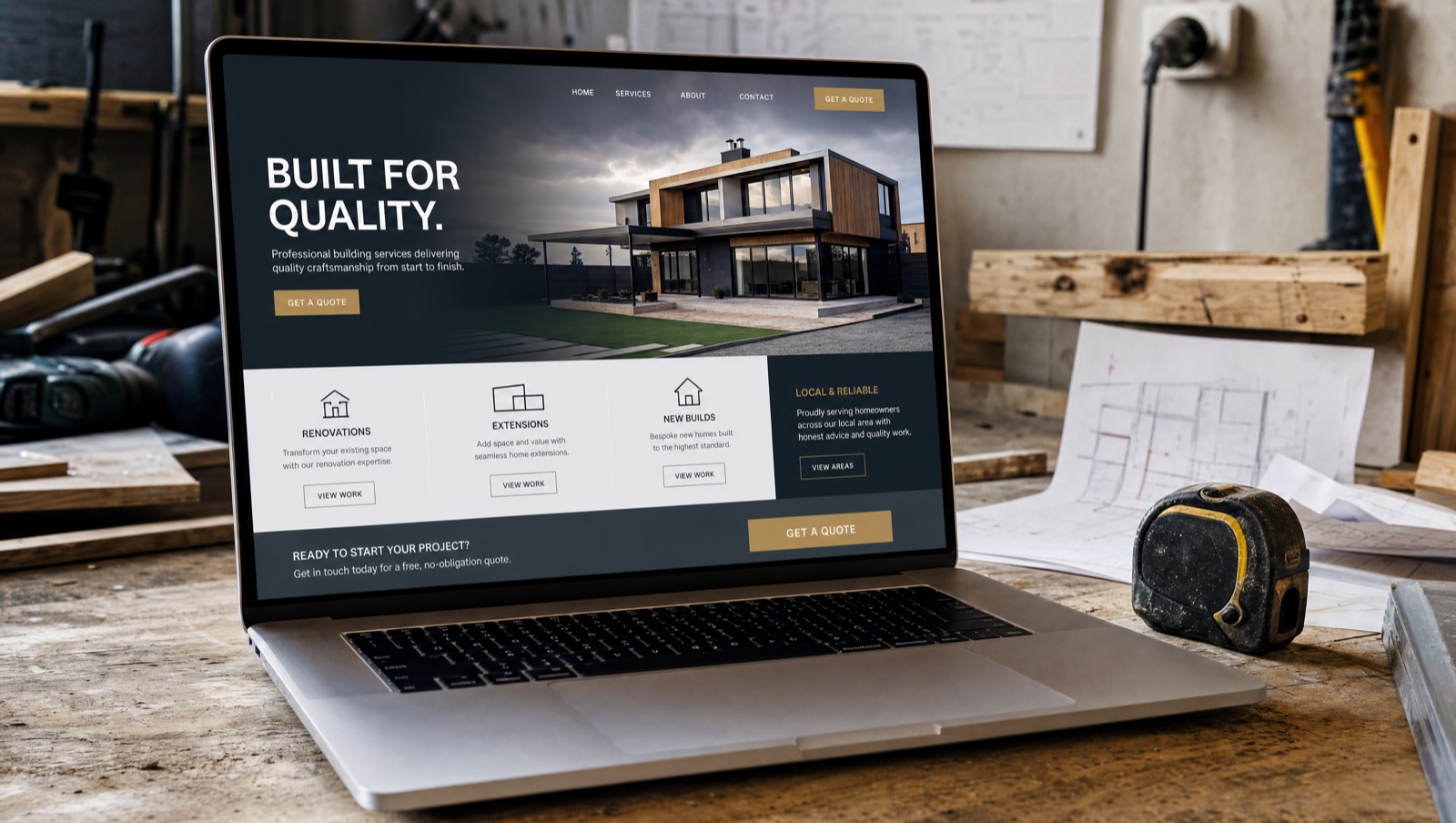
A tradesman website needs eleven things to turn local search traffic into booked jobs in 2026: a tap-to-call number, clear service area, one page per service, accreditations, real reviews, before-and-after photos, an emergency line if you offer one, a proper contact form, pricing guidance, local SEO fundamentals, and a mobile-first layout that loads in under three seconds. Get those eleven right and the site has the structure most weak local trade sites are missing.
Why this list exists
Most tradesman websites I look at are broken in the same three ways. The phone number is small, the service area is vague, and there's no proof the person has actually done the work. Fixing those three costs nothing and fixes most of the lost enquiries. The other eight points on the list are what separates a site that gets jobs from a site that merely exists.
I'm writing this as a one-person studio that builds sites for tradespeople across the UK. The specifics below are the actual brief I'd use for a plumber in Leeds, an electrician in Birmingham, or a roofer in Glasgow. The trade changes, the structure doesn't.
1. Tap-to-call phone number, sticky on mobile
Seventy per cent of tradesman enquiries start on a phone. The visitor has a problem they need solving today, not a form they want to fill in. The phone number should be in the top bar, visible on every page, and formatted as a tel: link so one tap dials it.
On mobile it should be sticky, meaning it stays at the bottom of the screen as the visitor scrolls. A "Call now" button that doesn't move is the single highest-value element on a tradesman site. Every plumber and electrician site I build has one.
2. Service area, clearly stated
"I cover London" is too vague. "I cover Clapham, Brixton, Streatham, Tooting, and Wandsworth" is useful. Even better: a map with a radius drawn on it, or a text list of postcodes.
This matters for two reasons. One, the customer knows immediately whether you'll come out. Two, Google reads the place names and ranks the site for local searches. A plumber in Birmingham whose website lists Harborne, Kings Heath, and Moseley will rank for all three.
3. One page per service
Here's the rule: if you'd send a different quote for it, it needs a different page.
A plumber might need: boiler repair, boiler installation, leak detection, bathroom installation, emergency plumbing. That's five pages, each with a headline matching the search someone would actually type ("emergency plumber in Bristol", "new boiler installation cost"), each 400-800 words, each with photos and a CTA.
A sprawling "Services" page listing everything as bullet points will always lose to a competitor who has built five focused pages. This is the single biggest SEO advantage for trade sites and the most often skipped.
4. Accreditations, visible and verified
For plumbers: Gas Safe Register number. For electricians: NICEIC, NAPIT, or Elecsa registration. For roofers: CompetentRoofer, NFRC, Trustmark. For gas work: Gas Safe. For heat pumps: MCS.
Put the logos at the bottom of the homepage and on every service page. If you've got the register number, show it. Customers who search for "Gas Safe plumber near me" read these logos the same way they'd read a professional licence on a shop wall.
Don't display an accreditation you don't actually hold. Customers check. Google checks. It's not worth it.
5. Real customer reviews with real details
Five reviews with full names and locations beat twenty anonymous five-star ratings. The specificity is what builds trust. "Bob from Altrincham, boiler replaced in one day, priced as quoted" is evidence. "Great service, would use again" could be anyone.
Pull the best five from your Google Business profile and reproduce them on the homepage. Link to the full Google profile so anyone who wants to see the raw feed can. A widget that pulls them live is fine if your site supports it.
If you don't have five reviews yet, ask your last ten customers. Most will leave one if you send them the direct link the day after the job.
6. Before-and-after photos
This one applies strongly to roofers, decorators, painters, and bathroom fitters. Less to electricians, more than nothing to plumbers.
The rule: take before-and-after photos on every single job. Ten pairs on the website beats any amount of prose. The customer can see you've done work that looks like what they need, on a house that looks like theirs, in a town that looks like theirs.
Store them organised by service and by location. If you ever want to bid for a job in a specific postcode, being able to show three recent jobs within two miles is close to decisive.
7. Emergency number, if you take out-of-hours work
If you take emergency call-outs, say so prominently and have a dedicated line or after-hours instruction. "24/7 emergency plumber in Manchester" is a valuable search term that's much easier to rank for than "plumber in Manchester".
If you don't take emergencies, say that too. Don't leave it ambiguous. A clear "Hours: 8am-6pm, Monday to Saturday" is better than nothing because it filters out the calls you can't serve.
8. Contact form, three fields maximum
Name, phone, problem in a sentence. That's it. Every extra field is an extra 5% of people who give up and close the tab.
Don't ask for postcode, job type, preferred callback time, and company name. You can ask those things on the phone when you ring back. Get the lead first, qualify second.
9. Pricing guidance, even if rough
"From £50 for a call-out, new boiler installation from £1,800" is infinitely better than no price at all. The customer who sees no price either assumes it's expensive or moves on to a competitor who showed numbers.
You don't have to quote a finished job. A call-out fee, a starting price, a typical range: each is a signal that you're not hiding. Fixed-price boiler quotes are worth more to the customer than three paragraphs of "we offer competitive pricing".
10. Local SEO fundamentals
This is the unglamorous part and it's what actually puts the site on the first page of Google.
City in the page title of every page. Proper schema markup (LocalBusiness, Service). Google Business profile claimed and linked. An address on the site, even if it's a home-office postcode. Consistent NAP (name, address, phone) across the site, the Google profile, and any directories like Checkatrade.
If you're in a competitive market like London, you'll also want dedicated city-and-service pages, for example "emergency electrician in Clapham" as its own URL.
For the broader setup, read local SEO for a small business website. It is the same foundation I would use before building out trade-specific service-area pages.
11. Mobile-first, fast-loading, no tricks
Over 70% of tradesman site traffic is mobile. If the site works on a laptop but breaks on an iPhone, you're losing the majority.
The site should load in under three seconds on a 4G connection. That means compressed images, no autoplaying video, no heavy template libraries. A plain, fast site beats a slow pretty one every time for a trade business because the customer's in a hurry.
How to use this checklist
Print it. Open your current site on your phone. Go through the eleven points and mark each as done, half-done, or missing. If you've got more than three missing, you're leaving enquiries on the table.
I build sites for tradespeople that have every one of these by default. A Starter at £250 covers a one-trade site with the basics done properly. A Business at £400 gives you room for per-service pages and per-area landing pages, which is what most established tradesmen actually need to compete.
If you already have a trades site, send it through the free website check before you rebuild it. If the budget is the main question, the website design under £500 guide explains what is realistic.
If that sounds like what you want, tell me about your trade and your patch and I'll price a site that ticks every box on this list.
FAQ
What's the single most important thing on a tradesman website?
A phone number that works on mobile, big and tap-to-call, visible on every page. Most tradesman enquiries come from someone with a leak or a blown fuse who wants to call, not submit a form. If the number is hard to find, the job goes to the next Google result.
Do I need separate pages for each service I offer?
Yes, if you want to rank for them. A single 'Services' page with six services listed as bullets will never outrank a competitor with six dedicated pages. One page per service, each written for the search someone would actually type, is the difference between being found and not.
How many customer reviews do I need on the site?
Five is enough to start, twenty is plenty. The quality of the reviews matters more than the quantity past a certain point. Full names, locations, and specific details beat ten generic five-star ratings. Link to your Google Business profile for proof.
Should my tradesman website have a blog?
Only if you'll write it. An empty blog with two posts from 2024 is worse than no blog at all. If you will genuinely post once a month about jobs, problems, and local questions, a blog helps SEO meaningfully. If you won't, leave it off.
Do I need before-and-after photos?
Strongly yes for roofers, painters, decorators, and anyone whose work has a visible result. Take them on every job. A clean gallery of ten before-and-afters beats a list of bullet points every time, because the customer can see you've done it before.