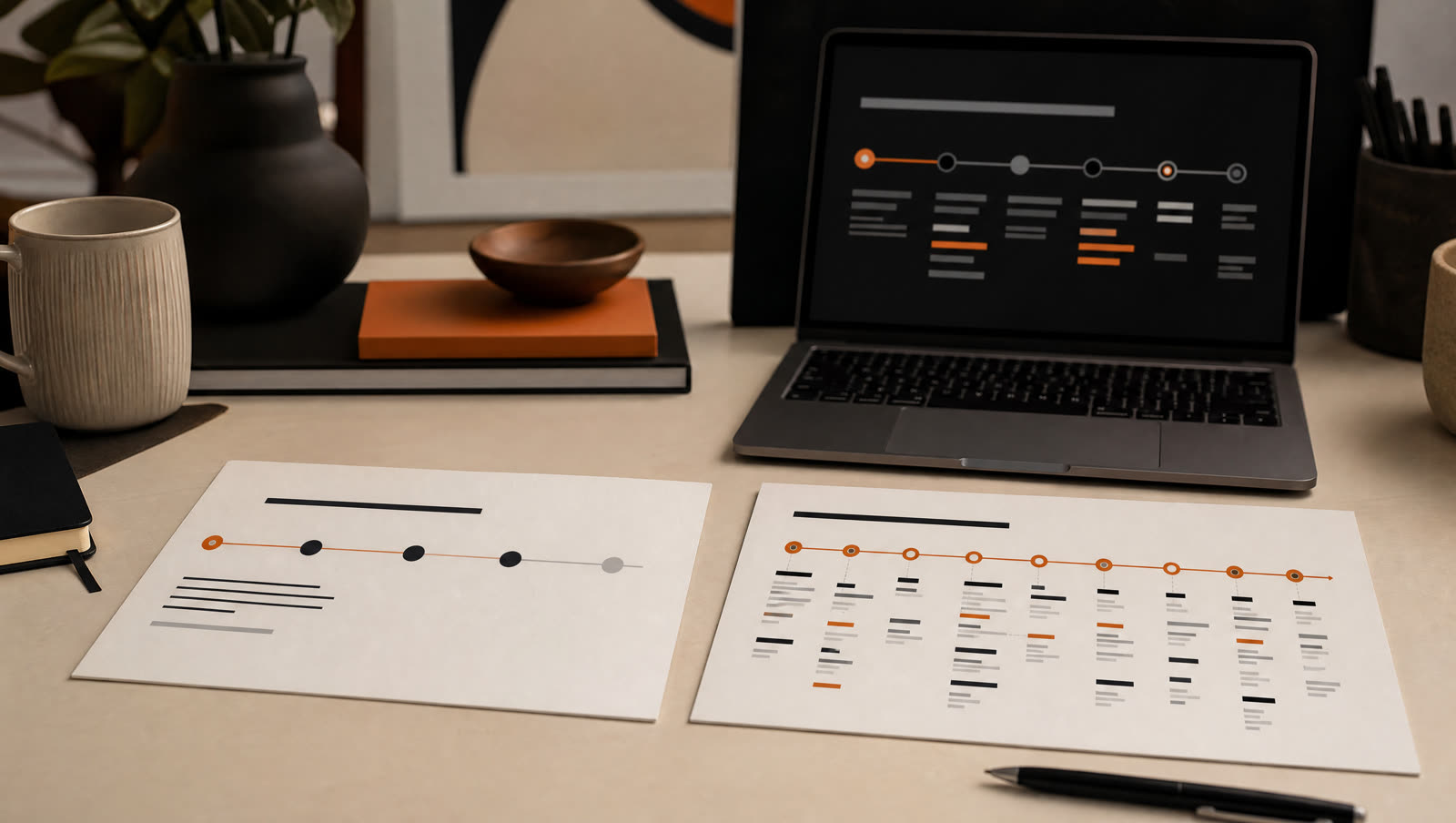
A 10-day website build and a 5-month agency project can produce sites that look and perform similarly on the day they go live, because most of the 5 months is meetings and handoffs rather than craft; what genuinely differs is the amount of strategy baked in, which matters for some businesses and is pure overhead for most. For a small business brochure or service site, the 10-day build wins on cost, speed, and direct communication without costing anything in quality.
What a 5-month agency project actually spends five months on
If you zoom in on a typical five-month small business agency project, the calendar doesn't look the way most clients expect. Here's a rough version of how the months break down:
| Week | What's happening |
|---|---|
| Weeks 1-3 | Discovery, kickoff, stakeholder interviews, workshop |
| Weeks 4-6 | Strategy deck, brand review, sitemap, wireframes |
| Weeks 7-10 | Design rounds, client reviews, revisions |
| Weeks 11-14 | Development, build, integrations |
| Weeks 15-17 | QA, content input, pre-launch reviews |
| Weeks 18-20 | Launch window, training, handover |
Look at where the time actually goes. Roughly 40% of the project is design and build, and roughly 60% is meetings, documents, and the admin of coordinating a team. That 60% is the agency's overhead made visible. It isn't quality. It's coordination cost.
For a client who needs stakeholder alignment across a marketing team, a product team, and a compliance team, that coordination cost is the point. For a sole trader who owns the whole decision, it's pure drag.
What a 10-day build actually spends ten days on
Here's my version, for context:
| Day | What's happening |
|---|---|
| Day 1 | Brief received, scope confirmed, fixed quote signed |
| Days 2-3 | Sitemap, homepage wireframe, design direction |
| Days 4-7 | Design and build, one round of client review |
| Day 8 | Polish, SEO setup, performance tuning |
| Day 9 | Final client review, any last tweaks |
| Day 10 | Launch |
No weekly status meeting. No 40-slide strategy deck. No handover between a designer and a developer who've never met the client. One person, one project, one conversation.
The work that happens is real design and real code. The work that doesn't happen is the coordination tax. That's the whole trick, and it's why the price can drop from £15,000 to £250 without the finished site looking £14,750 worse.
What's genuinely different in the finished sites
I don't want to pretend there's no difference at all. There is. Here's the honest list.
Strategic depth. An agency usually starts with a formal positioning exercise, competitor research, customer interviews. That feeds into the design. For a café in Oxford or a hairdresser in Cardiff, this level of strategy is overkill. For a consumer brand launching a £2M product, it's essential. I do lightweight strategy on every project. I don't do the five-week version.
Number of design iterations. My Starter includes one round of revision, Business includes two, Growth includes three. An agency project might run five or six rounds across different stakeholders. More rounds isn't always better. Every round introduces new opinions, and after three rounds small business sites usually start drifting away from the good design the first round produced. Diminishing returns are real here.
Volume of pages. A ten-day build for me caps at around eight pages comfortably, or more with Growth tier. An agency project with 25 team members can genuinely build a 40-page site in parallel. For most small businesses, 40 pages is a liability, not an asset. Each extra page is something to maintain and something for Google to rank badly if it's thin.
Documentation. Agencies produce heavy documentation: brand guidelines, design systems, component libraries. That's useful if a bigger team will take over the site later. It's unused for a sole trader who just needs the site running.
What isn't different, despite what the agency pitch says
Design quality. A solo founder with a modern toolchain can produce design that's genuinely indistinguishable from a mid-sized agency's output on a small business project. The tools are mature, the references are the same, and the eye of the designer is the variable that matters. A careful solo designer beats a rushed agency junior every time.
Code quality. Next.js, Tailwind, modern hosting. A one-person studio ships the same stack an agency does, sometimes cleaner because there aren't three people's opinions baked into the codebase.
SEO. On-page SEO is a checklist, not an art form. A solo builder who knows the checklist delivers the same result an agency SEO specialist delivers for a ten-page site.
Performance. Page speed is almost entirely a function of what's shipped, not who shipped it. A simple hand-coded site is usually faster than an agency-built site weighed down by tracking scripts and plugins.
Accessibility. Same deal. The rules are defined. Either the site follows them or it doesn't. Timeline doesn't determine that.
The clean way to pick
Ask one question: how many people inside your business need to approve the website?
If the answer is one or two, you're the decision-maker and the process that works for you is direct. Ten-day build, one person, fixed price. Agency overhead is money you don't need to spend.
If the answer is six or more, you need the formal process. A committee can't make decisions on a ten-day clock. Agency cadence is the right fit.
For most small businesses the answer is one. For most plumbers, dentists, restaurants, and freelancers the answer is one. For a business in Liverpool or Sheffield where the owner is also the marketing director, it's one.
The economics the agency doesn't show you
Here's the side-by-side cost view on a straight-swap small business site:
| Item | 10-day build | 5-month agency |
|---|---|---|
| Upfront fee | £250-£1,000 | £8,000-£25,000 |
| Opportunity cost (your time in meetings) | ~3 hours total | ~20-40 hours total |
| Time to first enquiry | Week 3-4 | Month 6-7 |
| Maintenance afterwards | Optional £79/mo | Typically £500-£2,000/mo retainer |
The "time to first enquiry" line is the one people forget. If a ten-day site starts generating leads in month one, that's four months of leads the five-month project hasn't started collecting yet. For a personal trainer or an accountant with steady demand, four months of missed enquiries easily dwarfs the fee difference on its own.
The failure modes of each approach
Fast, done wrong: scope mismatch. A £250 Starter tries to deliver what a £2,000 build needs. The scope doesn't fit, the work suffers. The fix is choosing the right tier, not rejecting fast builds.
Slow, done wrong: design by committee. The site gets compromised through six rounds of revision with eight stakeholders until the edges are sanded off and nothing has a point of view. The fix is fewer cooks, not a longer timeline.
Both failure modes are about process discipline, not speed. A well-run ten-day project and a well-run five-month project can both ship work to be proud of. A badly run version of either ships something nobody loves.
When to pick which, in one paragraph
If you're a small business, a sole trader, a freelancer, or a local service in any UK city, the ten-day build is almost always the right shape. You get a site that looks agency-level, for a fraction of the cost, and you get it live in time to start collecting customers this quarter.
If you're a mid-sized company with multiple stakeholders, a compliance process, complex e-commerce, or a brand project where the strategy is the actual deliverable, the longer agency process earns its fee.
If you are comparing this against a hard budget, I wrote a separate guide to website design under £500. If you already have a site and cannot tell whether speed, structure, or copy is the problem, start with a free website check.
If the ten-day shape sounds like what you want, send me a brief and I'll come back with a fixed price and a launch date inside two weeks.
FAQ
How can a 10-day website possibly be as good as a 5-month one?
Because most of the 5 months is meetings, handoffs, approvals, and slide decks. The actual design and build is a small slice of the total. A solo founder running their own process cuts the overhead, not the craft. The finished files can look remarkably similar.
Isn't a fast build a lower-quality build?
Not automatically. Fast is only bad when it means skipping steps. My ten-day build does the same steps as a longer agency process, just without the meetings between them. Design, copy, build, review, polish, ship. The clock is shorter. The work isn't.
When is a 5-month agency project genuinely worth it?
Two cases. One, complex e-commerce with integrations, compliance, and dozens of stakeholders. Two, big brand projects where the strategic research and stakeholder alignment are the job. For a small business brochure site, five months is overhead, not quality.
Do I get the same level of care on a 10-day build?
You get more direct care, actually. Every detail is checked by the person who builds the site. There's no designer-to-developer handoff where decisions get re-interpreted. The site is the opinion of one person, not the average of six.
What's the failure mode of a 10-day build?
Scope. If I tried to build a 40-page e-commerce site with a booking system and three integrations in ten days, something would slip. That's why the tiers are set where they are. Starter at 10 days is up to four pages. Business and Growth at 14 days are wider scope. Match the tier to the work.